Emerging AI Weekly: November 6, 2026
What’s new in AI this week: shopping agents went multimodal and in-store, frontier models turned to cybersecurity at scale, image generation got faster, and regulators opened a personalized-pricing inquiry.
Emerging Signals
- Walmart’s Sparky AI agent can now turn uploaded pictures, including handwritten lists, into shopping carts, and can light up an item’s shelf label in store. Read more
- Amazon told investors that 400 million customers have used Alexa for Shopping in the last 12 months, with interactions up 570% year over year. Read more
- OpenAI introduced Images 2.6 with GIF creation, 50% faster generation, and new API controls for developers. Read more
- OpenAI’s security research pipeline produced 948 working Linux kernel privilege-escalation exploits plus candidate patches, at a cost of $1,279 per exploit. Read more
- OpenAI made its Daybreak Red cyber models available to approved government customers in AWS GovCloud. Read more
- Google DeepMind gave its Antigravity agent new cheminformatics skills that compress days of drug-discovery workflow into about an hour. Read more
- The FTC ordered Walmart, Target, and seven other companies to detail how personal data and AI may be used to vary prices from one person to the next. Read more
- Baidu open-sourced Ernie 5.5 Flash Base, a 280-billion-parameter model, according to AIbase’s November 5 daily briefing. Read more
- Apple’s iOS 27.3 beta in mainland China integrates Alibaba’s Qwen models for Apple Intelligence, taking over the role ChatGPT plays overseas, according to AIbase. Read more
- ASTM International and Enterprise Singapore released a white paper identifying standardization priorities for the responsible growth of embodied AI systems. Read more
Model Releases & Research
OpenAI Introduces Images 2.6 With GIF Creation
The News: OpenAI introduced Images 2.6 in ChatGPT, Codex, and the API on November 4, adding GIF creation, generation that is 50% faster, and more precise editing that keeps characters, products, and brand details consistent. The company says people now create 4 billion images per week across ChatGPT, Codex, and the API, and that the Flare variant can generate an image in as little as six seconds at low quality. The API offers GPT-Image-2.6 Flare and Sunburst, and adds image markup, SVG exports, and a new complexity parameter that controls how much planning the model does. Read more
What It Means:
- For retailers: Turning a product shot into an eye-catching loop and keeping brand details consistent across edits are catalog-production tasks – this release lands directly on creative and marketing workflows.
- For executives: 4 billion images per week means customers are already fluent in AI-generated visuals, so the quality bar for brand content keeps rising.
- For engineers and researchers: The new complexity parameter and SVG exports show image models maturing into production tools with explicit cost-versus-quality controls.
Google DeepMind Turns Antigravity Into a Science Workbench
The News: Google DeepMind published “Agentic cheminformatics with Google Antigravity” on November 3, introducing Cheminformatics Skills that let the Antigravity agent search thousands of compounds, run matched molecular pair analysis, and propose novel rigidified macrocycles with synthetic routes in about an hour. The skills are grounded in RDKit, with connectors to curated resources from ChEMBL and PubChem, and the language model handles orchestration and reasoning while deterministic chemistry tools execute the molecular calculations. DeepMind is also offering 10,000 scientists the highest usage tier in Antigravity free of charge for six months. Read more
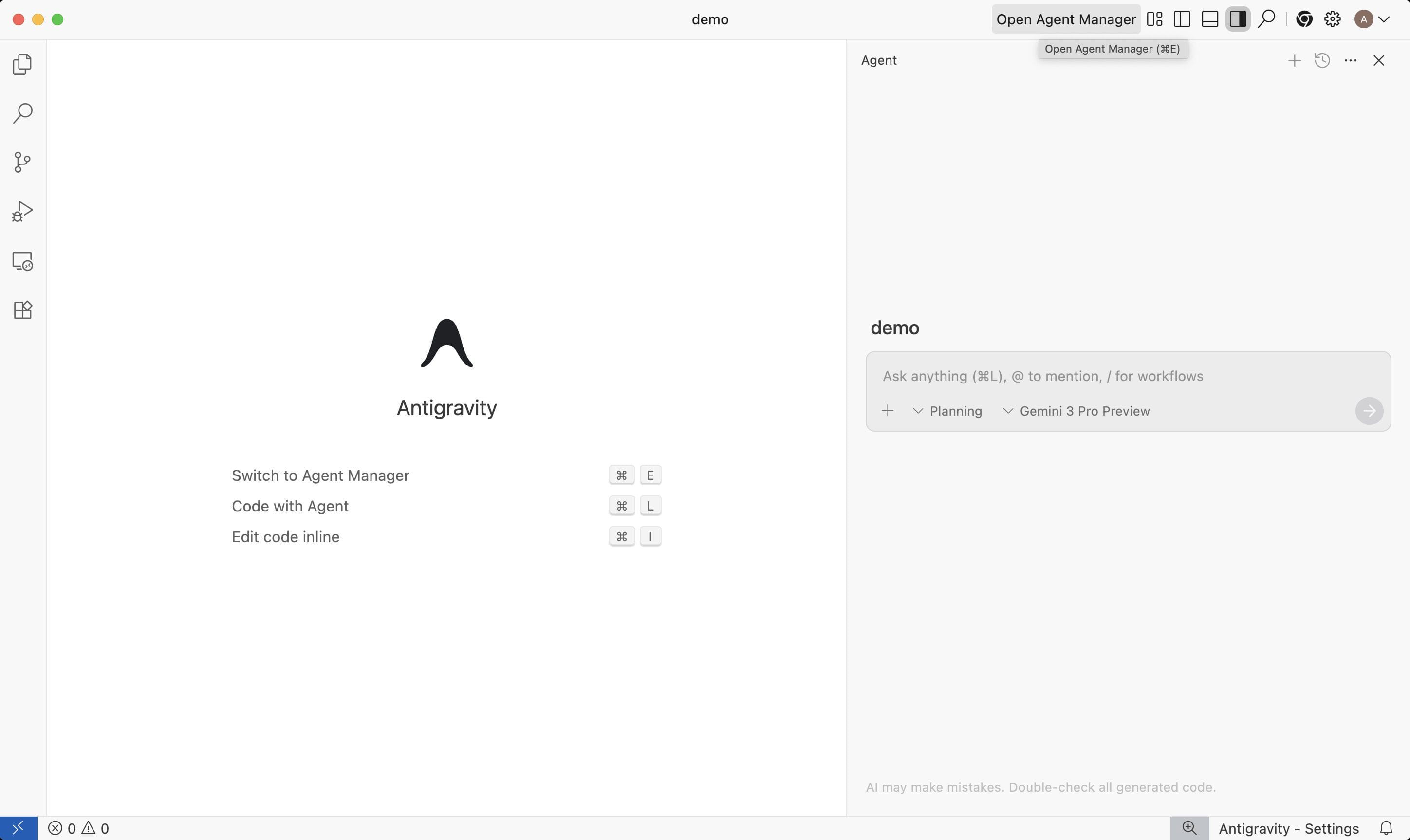
Image: Google Antigravity, via xFanatical
What It Means:
- For engineers and researchers: The pattern is a general-purpose agent plus a curated domain skill pack plus deterministic tools – the same architecture that will arrive in retail domains like assortment and pricing.
- For executives: The “days of work compressed into an hour” framing is the productivity claim employees will soon bring to every knowledge workflow, so expect rising pressure on internal tooling.
- For students: The division of labor here is the concept to learn: the model reasons and orchestrates, while verified tools do the calculations that have no margin for error.
Safety & Trust
OpenAI’s Autonomous Pipeline Produced 948 Working Linux Kernel Exploits
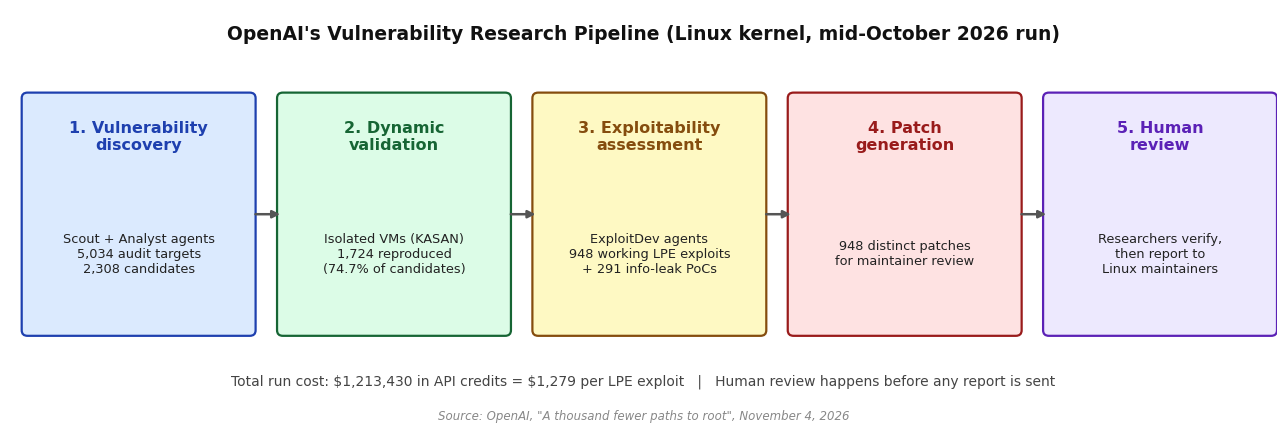
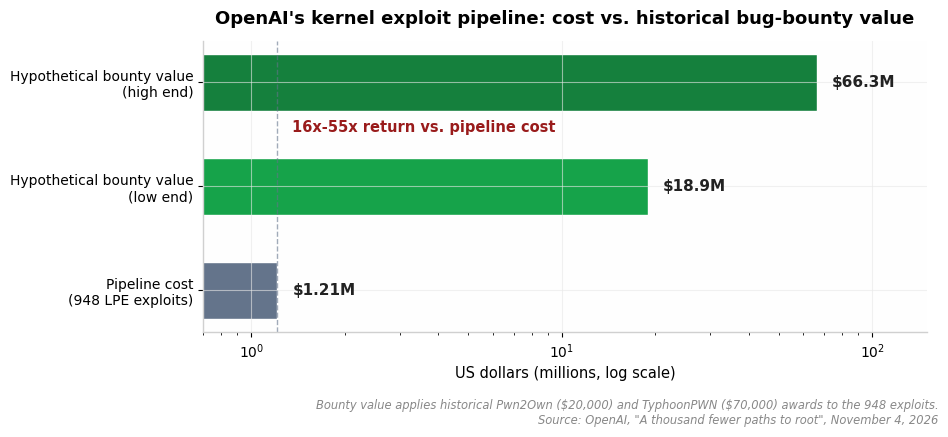
The News: In a security research post published on November 4, OpenAI described a prototype pipeline that identified 2,308 candidate Linux kernel findings, dynamically reproduced 1,724 vulnerabilities, and produced 948 working local privilege escalation exploits along with candidate patches for maintainer review. The mid-October run cost $1,213,430 in API credits, or $1,279 per exploit, which OpenAI compares with historical bug bounties that would value the 948 exploits at $18.9 million to $66.3 million. Human researchers reviewed the outputs before vulnerabilities were reported, and OpenAI says the agents used at least ten exploitation techniques that were novel to third-party kernel experts. Read more
What It Means:
- For executives: Every large retailer runs on Linux somewhere, from store systems to cloud infrastructure, so exploit discovery at this cost changes the patching math for any security organization.
- For engineers and researchers: The same capability is available to attackers, which compresses the window between vulnerability disclosure and exploitation – patch velocity is now a defensive metric.
- For students: Note the pipeline design: Scout agents pick targets, analyst agents scan, triage agents validate, and humans review before reporting. Agentic security work is becoming an assembly line.
OpenAI Brings Daybreak Red Cyber Models to AWS GovCloud
The News: OpenAI announced on November 4 that Daybreak Red is now available in AWS GovCloud (US-East), giving approved customers access to GPT-5.6 Cyber through Amazon Bedrock for authorized vulnerability research, exploit validation, and security testing. Daybreak Red gives verified defenders fewer refusals for authorized cybersecurity work, alongside stronger identity verification, monitoring, and access controls. OpenAI says inference data from Daybreak Red on Bedrock is not used to train models, and customers do not need to share their Daybreak Red data with OpenAI. Read more
What It Means:
- For executives: Frontier vendors are building gated, purpose-trained model tiers for sensitive work, and that pattern will likely extend to other regulated domains.
- For retailers: Enterprise AI procurement is shifting toward verified-access programs rather than open APIs for high-risk tasks – expect this model to show up in vendor evaluations.
- For engineers and researchers: Cybersecurity capability is now a marketed frontier-model feature, which raises the baseline for what internal red-teaming tools can do.
Retail & Grocery
Walmart’s Sparky Agent Now Turns Pictures Into Shopping Lists
The News: Walmart announced in an October 30 press release that its AI shopping agent Sparky can now use images uploaded by the user to answer questions or create shopping lists, including turning a picture of a handwritten list or a digital list exported from the Notes app into a shopping cart, PYMNTS reported. Other new capabilities let in-store shoppers search for an item with Sparky, walk to the aisle shown on a store map, and tap “Flash price tag” to make the item’s shelf label light up, and Sparky can also generate recipes with ingredient lists, suggest healthier alternatives, and communicate in Spanish and French. Walmart expects to launch voice capabilities by the end of the year and is expanding Sparky beyond US customers to Canada, Mexico, and Sam’s Club members in the US. Read more
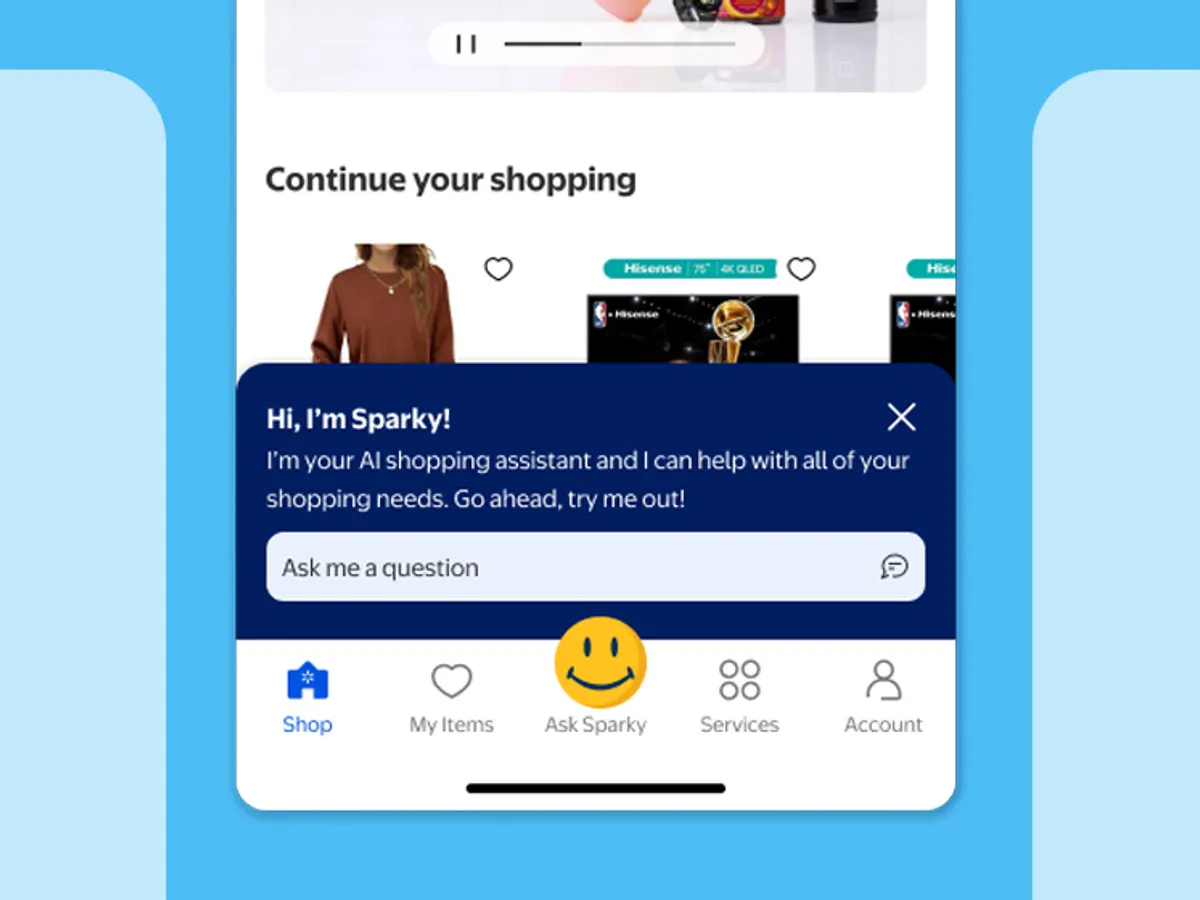
Image: Walmart, via Retail Dive
What It Means:
- For retailers: Photo-to-cart, recipe generation, and in-store item finding are now shipped features at the largest grocer – this release is a feature-by-feature benchmark for every competing assistant roadmap.
- For executives: The “Flash price tag” capability ties the assistant to electronic shelf labels, connecting the AI conversation directly to in-store hardware investment decisions.
- For students: Voice support plus expansion to Canada, Mexico, and Sam’s Club shows how a shopping assistant graduates from experiment to default interface – watch that lifecycle.
Amazon’s AI Shopping Assistant Is Attached to Real Grocery Economics
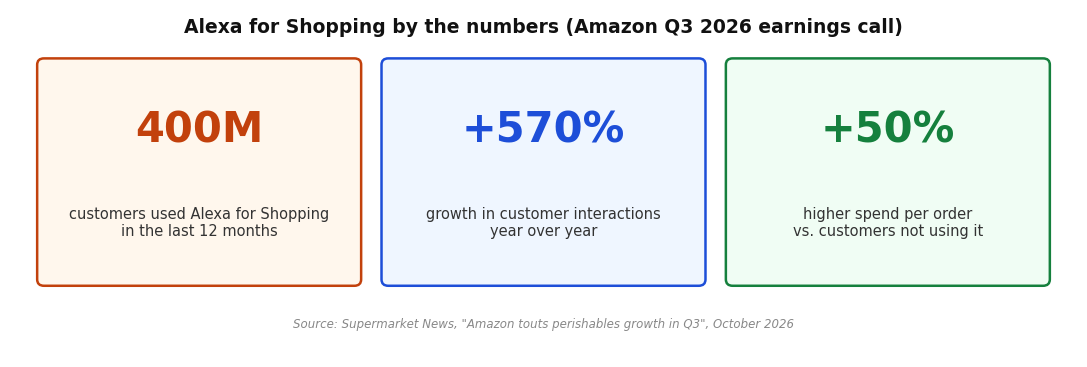
The News: Amazon said on its third-quarter earnings call that 400 million customers have used Alexa for Shopping in the last 12 months, with interactions up 570% year over year and users spending 50% more per order than non-users, Supermarket News reported. Sales of perishables and everyday essentials grew about three times faster than the rest of its store and represented about half of all units sold, while monthly same-day fresh grocery orders from Prime members have more than tripled in the past year. Overall results fell short of analyst estimates, with earnings per share of $1.89 versus the $1.97 consensus and revenue of $201.9 billion versus $202.25 billion expected, and reports said ongoing AI investments reduced the company’s cash flow in the quarter. Read more
What It Means:
- For retailers: The 50% higher spend per order among assistant users is the strongest public evidence yet that conversational AI changes basket economics.
- For executives: Amazon is proving that perishables plus same-day delivery is a working combination, which raises the stakes in fresh categories for every grocer.
- For students: The earnings miss alongside record assistant usage is a lesson in framing: investors tolerate AI spending when the consumer flywheel visibly turns.
FTC Orders Walmart, Target, and Seven Others Into Personalized-Pricing Inquiry
The News: The Federal Trade Commission ordered nine companies, including Walmart and Target alongside airline, ride-sharing, and food delivery firms, to provide details on whether personal data and artificial intelligence are used to vary prices from one person to the next, Retail Dive reported on October 29. The 15-page order also asks how companies adjust compensation based on personal information and how prices can vary with factors such as loyalty programs, and recipients have 45 days to respond. FTC Chairman Andrew Ferguson said the agency intends to scrutinize “the opaque methodology that some companies in these industries may be using to determine how much consumers pay or how much gig workers are paid.” Read more
What It Means:
- For retailers: Personalized pricing built on loyalty data is now an active regulatory target, and every major loyalty program sits inside that conversation.
- For executives: The 45-day response clock means this story develops through December – legal and data teams should assume industry practices will be benchmarked against whatever the FTC publishes.
- For students: Target’s public fact sheet, which states it does not use personal information to raise prices, is a template worth studying for how companies communicate about algorithmic pricing.
Open Weights & Consumer AI in China
Baidu Open-Sources a 280-Billion-Parameter Ernie Model
The News: Baidu open-sourced Ernie 5.5 Flash Base, a 280-billion-parameter model, with multiple benchmark results setting new state-of-the-art marks for its size, according to AIbase’s November 5 daily briefing. The briefing listed it as the first of the day’s eight AI topics. No further technical details were available on the source page at the time of review. Read more
What It Means:
- For engineers and researchers: The open-weight frontier continues to be pushed by Chinese labs, extending the US-Europe-China three-way race tracked in last week’s issue.
- For executives: Cheaper, capable open models keep lowering the cost of fine-tuning experiments for internal tools, which changes build-versus-buy math.
- For students: Watch for the model card and community benchmarks before drawing conclusions – launch-day claims need independent verification.
Apple’s iOS Beta in China Replaces ChatGPT With Alibaba’s Qwen
The News: Apple’s iOS 27.3 beta formally integrates Alibaba’s Qwen models for Apple Intelligence in mainland China, taking over the role that ChatGPT plays in overseas versions, AIbase’s November 5 daily briefing reported. The briefing describes an on-device and cloud collaboration mechanism for the Chinese version. This was one of eight topics in that day’s briefing. Read more
What It Means:
- For executives: The default assistant inside the world’s dominant smartphones is now negotiated market by market, which means consumer AI behavior will fragment by region and provider.
- For retailers: The assistant layer is where shopping intent will increasingly start, so which model powers the phone matters for how customers will discover products.
- For engineers and researchers: The on-device plus cloud split in the Chinese version is the architecture to watch as Apple ships assistant features in more markets.